
How Annotating While Reading Transforms 11+ Comprehension
Annotating while reading can turn 11+ comprehension from a memory test into an active thinking process your child can see on the page. It slows children down just enough to notice detail, stay focused and find evidence quickly when answering questions.
Why Annotation Matters for the 11+
When children annotate, they are doing something with the text rather than just letting the words wash over them. Every mark on the page represents a small decision: “Is this important? What does this tell me?” That decision‑making builds deeper understanding and makes it much easier to tackle tricky inference questions.
Annotation also helps with exam timing. Instead of rereading the whole passage to find one key detail, pupils can scan their notes and highlighted sections. This reduces panic, boosts confidence and leaves more time to think carefully about their written answers.
What Is an Annotation Key?
An annotation key is a simple set of symbols or colours that reminds your child what to look for as they read. Using the same key every time will build their confidence and reduce the mental load of deciding what to annotate in the exam.
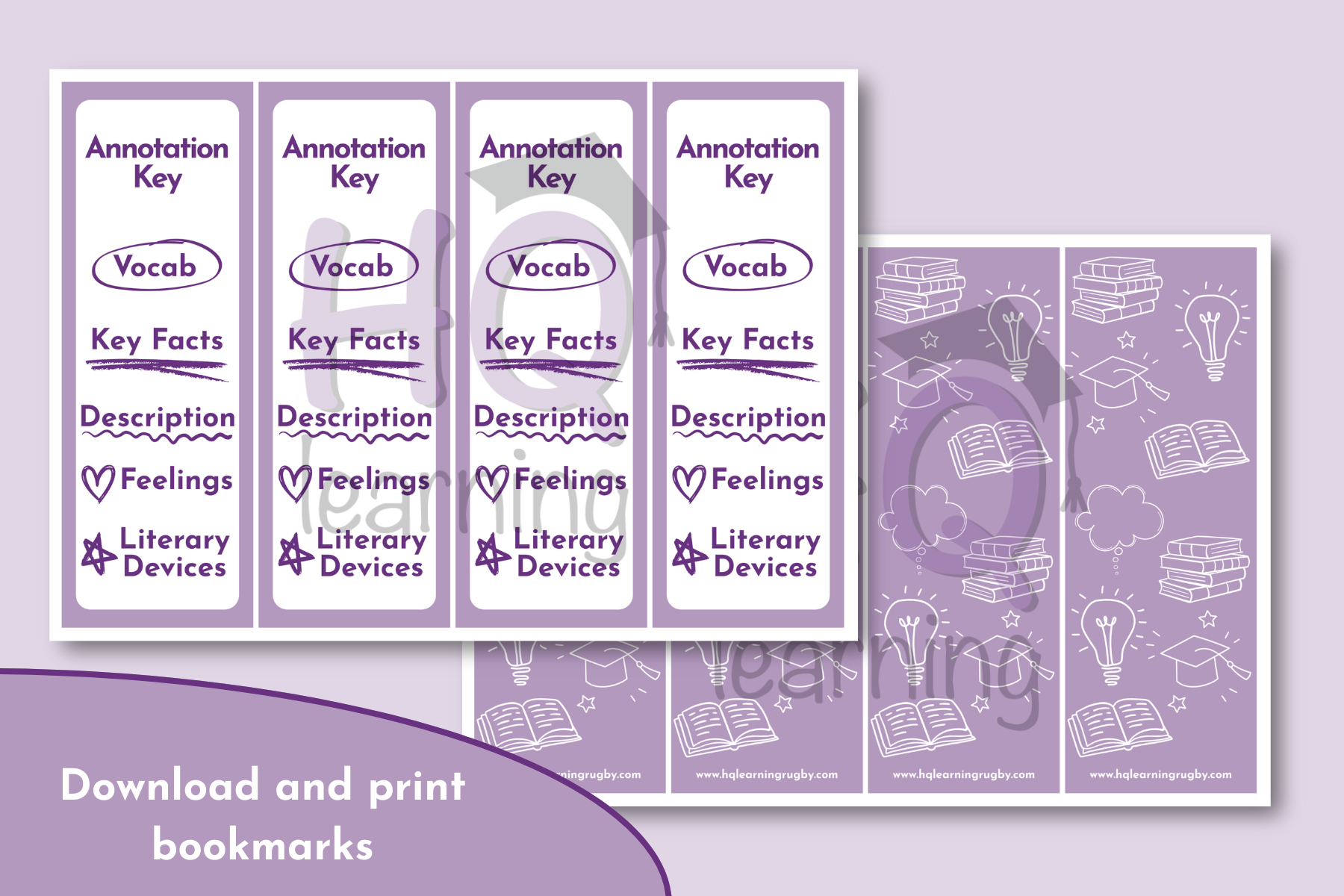
11+ Annotation Key Bookmarks – Printable Digital Download
Help your child turn every reading passage into an organised, high‑impact study tool with these printable Annotation Key bookmarks. Designed especially for 11+ preparation, each bookmark gives children a clear visual reminder of what to look for while they read:
Vocab – circled for tricky or new words
Key Facts – underlined so vital information stands out
Description – wavy underline for vivid setting and character details
♡ Feelings – to track characters’ emotions and mood
☆ Literary Devices – to spot similes, metaphors and other techniques
The double‑sided design features four identical bookmarks per page: one side with the simple annotation key, and the other with motivating, education‑themed illustrations (books, lightbulbs, graduation caps and more) in a calm purple palette.
Perfect for home learning, tutoring sessions or classroom use, this digital download can be printed as many times as you need. Just print on card (or print and laminate), cut along the lines, and your child has a ready‑made strategy in their book for every comprehension task.
Here’s the key I’ve been using with my 11+ students:
Vocabulary - circling unfamiliar or subject-specific words
Key facts - underline the key facts to answer who, what, when, where and why
Description - use a wiggly line for anything that helps you picture the setting or characters
❤️ feelings - anything that reveals how a character feels or their motives
⭐ literary devices - e.g. similes, metaphors, personification
This annotation code works well as students will only be allowed to use a pencil in the exam, so using different types of marks and symbols will help them to easily spot important details without additional colours or highlighters.
3‑Step Reading Routine
You can help your child build an annotation habit with a straightforward routine like the one I use in my 11+ sessions.
Ready to read?
Spend 30–60 seconds on a quick skim and getting ready to read. Look at the title and the layout of the text. Ask questions like, “What type of text is this?” and “Who or what might this text be about?” This preview primes your child’s brain before they start detailed reading.Read Active and Annotate
Now read the passage in full using the annotation key. It can also be helpful to summarise paragraphs with 2-3 words in the margin.Read, Reason and Respond to Questions
Only after this first read should your child move on to the questions. It can be tempting for them to start answering questions as they read, but they are likely to miss out on understanding the overall meaning of the text. It can be helpful to identify key question words to help find the answers. Remind your child that answering 11+ questions is about reasoning - ruling out incorrect answers can be just as helpful as looking for the right one.
Over time, this routine becomes automatic. Your child learns that every comprehension passage, no matter how unfamiliar, can be tackled in the same calm, methodical way.
Common Pitfalls (and How to Fix Them)
When I ask students to highlight the text, more often than not, they end up colouring nearly every line. When everything is “important”, nothing stands out. This is why I developed the annotation key I use with my students. If you still find they are annotating too much, you can try setting a limit on the number of annotations per paragraph. When highlighting or underlining, students only need to pick out key words and not whole sentences. Annotations don’t need to make sense grammatically - they are just to help us understand the text and answer questions.
Another common issue is “pretty but pointless” annotation. Pupils decorate the page without actually thinking about what the text means. Using a key will help to focus their annotations, but you may want to check their understanding by asking them why they’ve highlighted words or to predict the type of question they might be asked about that detail.
Finally, many children focus only on obvious facts and miss the clues about feelings or tone. Using the heart and the star annotations can be really helpful here. Ask your child questions to think about what is being implied or the effect created by a particular phrase or sentence to encourage deeper thinking.
How You Can Support at Home
You do not need exam papers to build this skill; you can start with any book or text your child is interested in reading. Choose a short page or two, agree on your annotation key, and work through it together. Model your thinking out loud: “I’m circling this word because I don’t know it”, or “I’m marking this description because it helps me really see the setting.”
As your child gains confidence, move onto 11+‑style practice passages. Keep using the same key to help it to become routine when reading. When using their annotations to answer questions, ask your child to show you where they found the answer to a question or which notes they used to encourage them to see the value in their annotations.
This keeps the link clear between the marks they make on the page and the marks they earn in the exam. The long‑term aim is for your child to walk into the 11+ with a proven, repeatable strategy for any new text, and the confidence that they know exactly how to use it.
